

For generations, Pacific Northwest policymakers understood a simple idea: working forests deliver public benefits everyone depends on — clean water, wildlife habitat, wildfire risk reduction, and wood products — and rural communities closest to those forests must remain part of the system that manages them and keeps them productive. If policymakers want healthier forests and safer communities, restoration goals need to be matched by the capacity to carry them out. That means supporting a stable and predictable timber supply, retaining local processing infrastructure, and recognizing that rural workforce capacity is part of the solution. Rebuilding that connection is not just important for rural communities and wood production. It is essential for long-term forest health and wildfire resilience.
Today, the state of this “social contract” appears to be dangerously fraying, according to researchers at Oregon State University and the US Department of Agriculture. The group studied forest sector infrastructure trends across the Northwest region. What they found is evidence of serious concern. They found a steep loss of mill infrastructure over time. As Table 2 shows, the total mill count fell from 555 in 2000 to 315 in 2024. Yet even after that decline, rural counties still hold the largest share of remaining processing capacity. The message is hard to miss: as the region loses mills, it is also weakening the infrastructure that helps keep working forests working — and the rural communities most tied to them.
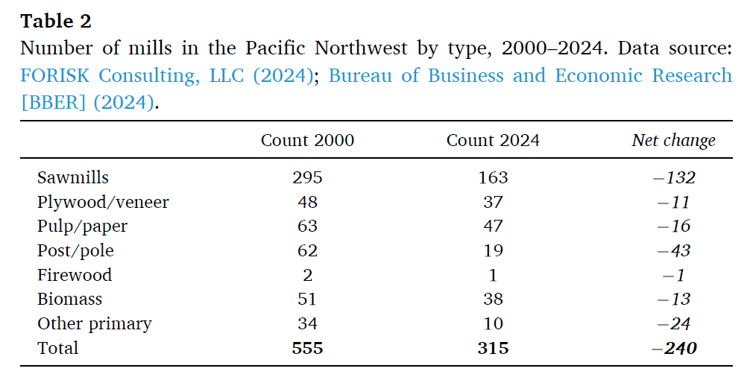 Published in Forest Policy and Economics, the study analyzed changes over the last 35 years driven by a major timber supply shock in the 1990s, tied to reduced federal harvest and the Northwest Forest Plan. The drastic policy shift and the rural recession that ensued weakened the direct role that rural communities played in the cycle of management, a trend that hasn’t ended. Not even close. Between 1958 and 1989, across Washington, Oregon, and California, the average annual timber harvest was 19 billion board feet. After the changes in the 1990s, by 2021 it had fallen to nearly half of that—9.7 billion. Rural counties took the steepest hit. The regions where we need an army of skilled forest managers tackling stewardship projects saw a total harvest falloff of 70% from all lands. Federal harvest cratered—dropping 96% between 1988 and 2001.
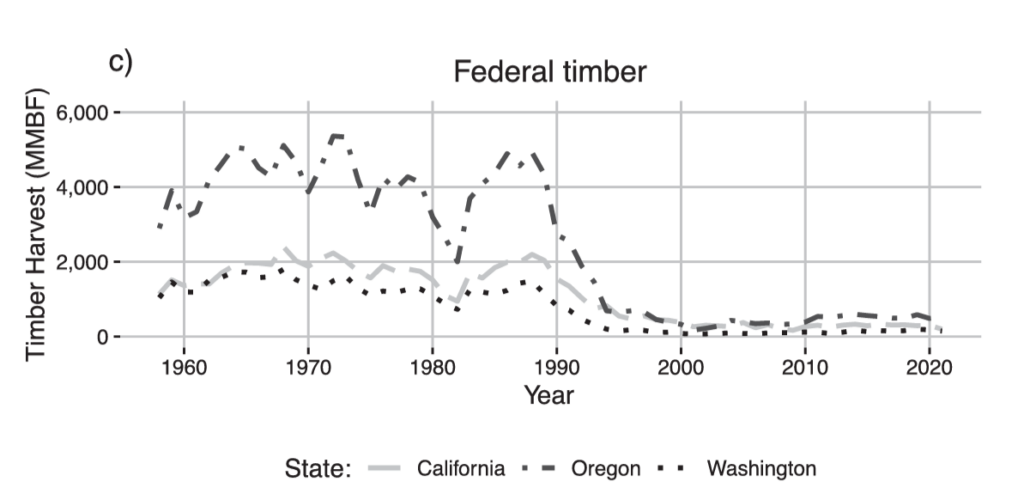 The drop in timber volume rippled through the network of local mills—a critical link in the supply chain. At a higher level, what happened was a rapid deskilling of specialized workforces in places where forests will always need to be managed. And it’s still happening today, even if more slowly.
The mill bones connected to the stewardship bone
Those losses matter because mills are more than buildings; they are the backbone of the forest management sector. When they close, communities first lose the jobs and investment, and then get hit again when the boomerang effect of the loss of productive capacity slows or suppresses forest sector investments overall.
In rural areas, a shortage of skilled workers and a community that doesn’t have a full stake in the work of stewardship is a critical problem for public policymakers whose goals are restoration, fuel reduction, and wildfire resilience. The authors warn that restoration and wildfire-risk-reduction work depend on having enough nearby workforce and processing infrastructure to remove and use material from the woods. Without that capacity, the work becomes harder and more expensive.
That is the challenge in front of us. Over time, policy changes reduced harvest and weakened the rural forest economy. Now, many of those same landscapes are expected to support large-scale thinning, restoration, and wildfire-risk reduction, even as the workforce and infrastructure needed to do that work have been reduced.
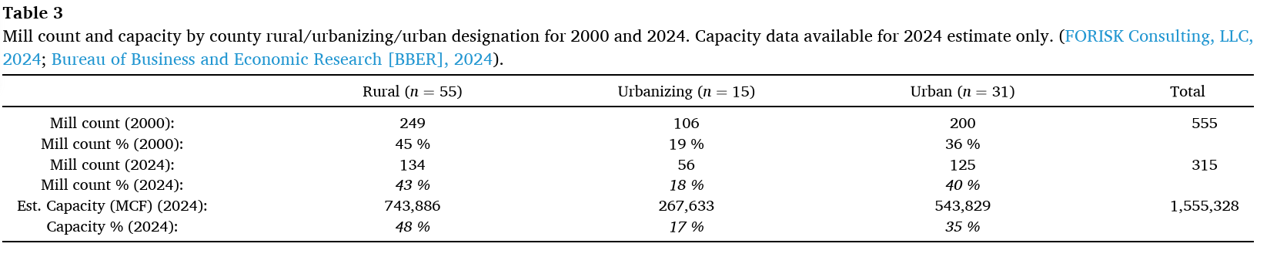
That remaining rural capacity still matters. Even after decades of decline, rural counties still accounted for 43% of the region’s mills and 48% of estimated processing capacity in 2024. Much of the infrastructure needed to support thinning, restoration, and fuel-reduction work is still located in rural communities. If public policy continues to weaken that foundation, it will only become harder to achieve the forest-management goals policymakers now say are urgent.
Working forests have never been just about timber. They are part of the Northwest’s identity, a source of skill, pride, and family-wage work, and a practical foundation for long-term stewardship. That is why this matters. A public policy agenda that asks more of forests while investing less in the people and infrastructure that manage them is not sustainable. If we want healthier forests in the decades ahead, we need to keep the rural capacity to do the work needed today.