
In a short legislative session, deadlines come fast. The 2026 Washington state 60-day legislative session is no different.
The session began January 12th and nearly six weeks later, lawmakers reached a significant milestone with the House of Origin Cutoff – the last day to consider bills in their house of origin. With the session scheduled to wrap up in less than a month on March 12th, we can expect the next three weeks to zip by.
Compressed cutoffs mean there’s less time for legislators to focus on major policy bills and nuanced policymaking. Below are some bills the Washington Forest Protection Association (WFPA) monitored due to their impact on private forest landowners and the forestry sector.
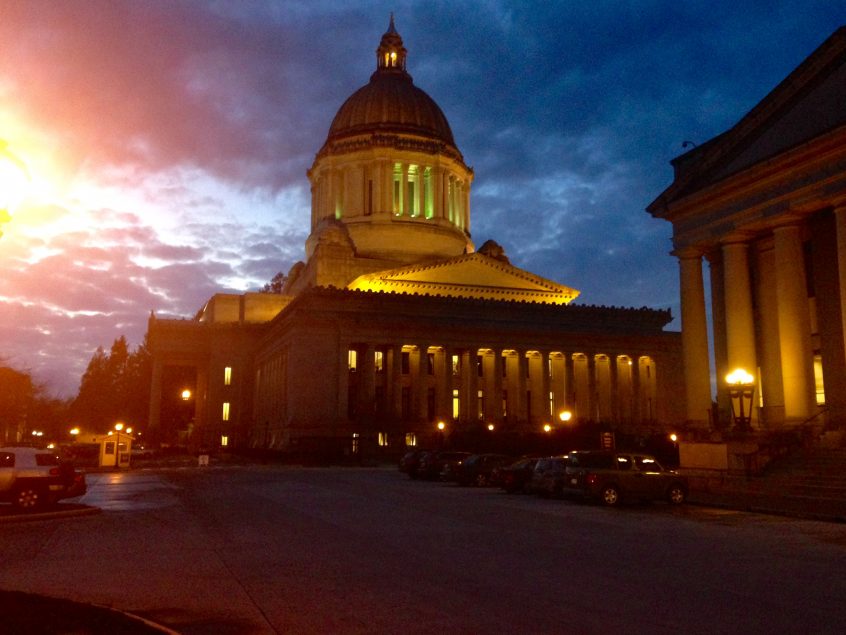
Capitol dome at sunset.
The bills that did not advance:
- HB 2275 : The bill would have paved the way to creating a state wildfire prevention council to address wildfire concerns near utility rights-of-way and fund to compensate property owners for wildfire damage caused by the utility’s negligence.
- HB 2170: The bill would have granted the state Department of Natural Resources permission to enter into contracts for payment for environmental service projects on all public lands, with contracts allowed to last for up to 125 years.
- HB 2620: The bill would have repealed and restarted the recently adopted riparian buffer rules for non-fish-bearing streams and require the forest practices rule-making process to include science-based recommendations and economic considerations.
- SB 5466: The bill would have created an electric transmission authority to ensure the reliability of the state’s power grid and increase access to affordable renewable energy. Looking through a forestry sector lens, the bill’s transmission buildout and vegetation management policy could have intersected directly with forest road access, culvert and water-quality liability questions, questions related to easement and condemnation, and ensuring a fair and accurate compensation framework that reflects both market land value and the long-term revenue of working forestlands.
While further deliberation on HB 2620 has concluded for at least this session, it was important that legislators were made aware just how far the recent Np rulemaking process strayed from the spirit and intent of the Forests & Fish Law. The Forest Practices Board’s (FPB) November 2025 decision to expand buffers on non-fish (Np) streams misapplied science and is expected to add costly and needless regulations while offering no consequential benefit toward salmon recovery. As a last resort, forest landowners initiated a legal challenge to the new rule to restore balance and science-based policy making.
Bills still in play.
- SB 5360: The environmental crimes bill is a holdover from the 2025 legislative session. The bill would make changes to the environmental crime framework, potentially affecting operational and compliance risk for landowners and forestry sector workers.
- HB 2089: The bill would expand the financial institutions required to pay B&O tax on interest income and loans secured by first mortgages and trust deeds to help fund wildfire response, forest restoration and community resilience projects.
- HB 2442: The bill would expand the use of local real estate excise tax (REET) revenue and authorize a 0.01% use tax to fund children and family services. Local fiscal tools can matter for forestry communities and the forestry sector since REET is a tax on the sale of land and standing trees.
And amid the policy talk is the lingering question of how lawmakers will close the $2.3 billion deficit in the current two-year budget, and whether it will include a major tax restructuring. This is the second consecutive year of budget shortfalls. Lawmakers have warned that significant program cuts and budgetary tightening will be necessary to close the gap, but a high-profile proposal referred to as the “Millionaires Tax” is on the table and could very well be Washington state’s first income tax. The proposal, SB 6346, would enact a 9.9% tax on income exceeding $1 million starting in 2028.
If one were to characterize this year’s Legislature in running terms: This session is a sprint and forestry is a marathon. As lawmakers race toward March 12 and grapple with the budgetary gap, WFPA will continue to advocate for science-based policy, practical rules that protect forests and fish alike, and legislation that helps
ensure working forests remain working.