WFPA advances policies that keep forests working, mills running, and rural communities thriving.
WASHINGTON FOREST PROTECTION ASSOCIATION
Riparian Buffer Zones
Buffer zones along streams are vital for protecting Washington’s water quality and supporting its diverse wildlife. These zones are safeguarded during timber harvesting on private forestland, in adherence to the Forests & Fish Law. This legislation has led to the expansion, enhancement, and maintenance of buffers along over 60,000 miles of streams across 9.3 million acres of state and private forestland in Washington.
The importance of these riparian zones lies in their contribution to the well-being of native fish, such as salmon and trout, as well as other wildlife. They serve three crucial functions:
- Temperature Regulation: Riparian buffers provide shade, which is essential for maintaining cool water temperatures, especially for salmon spawning.
- Water Filtration: The vegetation along stream banks stabilizes soil and filters rain and snow runoff, preventing sediment from entering the water.
- Habitat Creation: Fallen trees and branches from mature vegetation, known as large woody debris, create natural blockages in streams, forming pools that serve as vital resting and feeding areas for juvenile salmon.
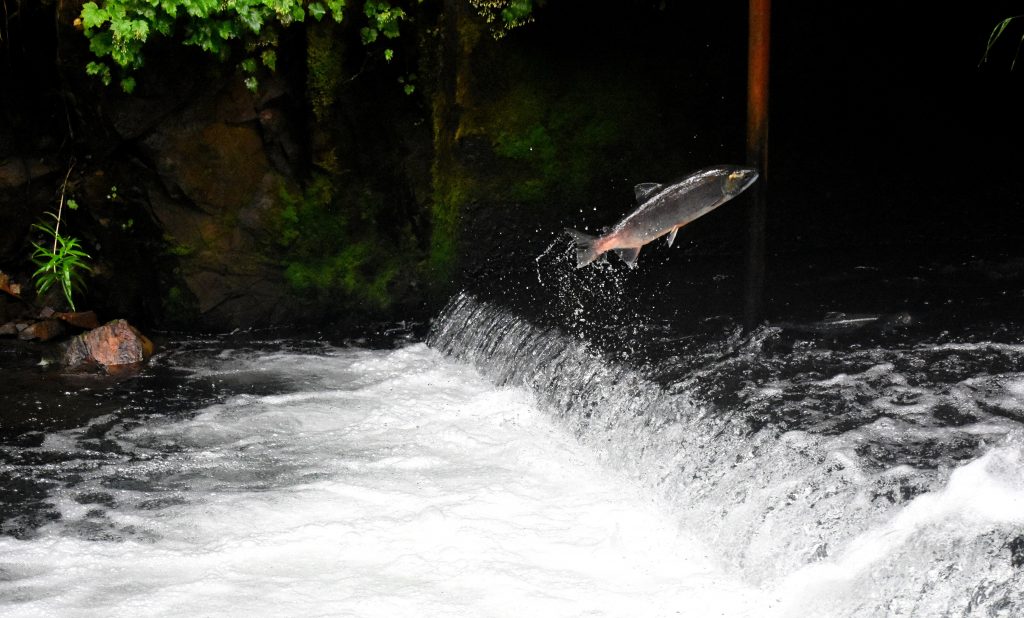
Fish, especially salmon, require cool, clean water. To reach a high quality of water for our fish habitat streams, buffers provide three important functions. The first is to provide shade to keep water temperatures cool, a necessity for spawning salmon. The second is to act as a filter for clean water. Vegetation along stream banks stabilize soils and filters rain and snow runoff–keeping sediment out of the water. The third function of buffers comes from mature trees that fall into streams, due to natural causes. These fallen trees and branches, called large woody debris, block and slow flowing water to create pools. These pools are essential resting and feeding sites for juvenile salmon.
Private Foresters Follow the Forests & Fish Law
Private foresters play a key role in adhering to the Forests & Fish Law, understanding the specific guidelines for buffer management during and after timber harvesting. These guidelines vary based on factors like tree height, stream size, and geographic location within Washington. The law ensures responsible forest management and aims to protect the environment and its inhabitants.
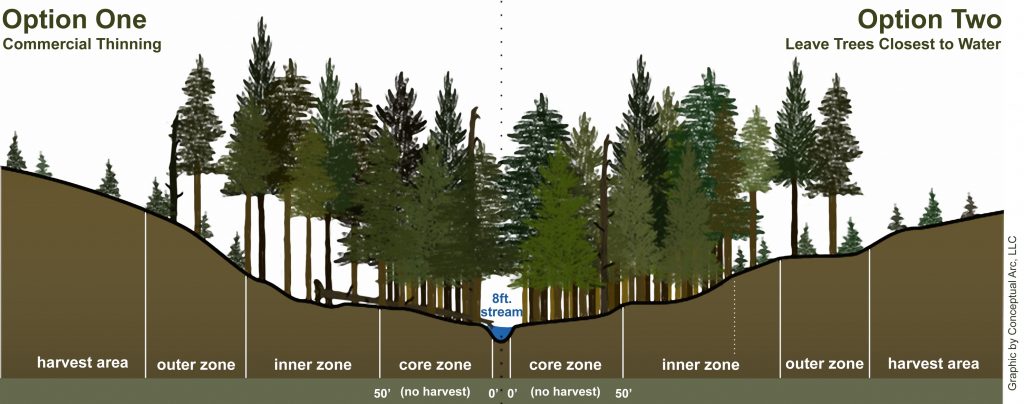
There are three distinct buffer zones defined under this law:
- Core Zone: This is a no-touch buffer zone extending from the stream’s edge for a designated distance, determined by the stream’s size.
- Inner Zone: Located immediately adjacent to the Core Zone, the Inner Zone allows for managed growth to maintain healthy riparian areas.
- Outer Zone: Management activities in the Outer Zone are influenced by actions taken in the Inner Zone and are subject to complex considerations.
These buffer zones work together to provide essential protection for aquatic resources while considering the economic interests of forest landowners.
For more information on managing the health of working forests and the significance of buffer zones, please explore further resources download info graphic here:
Different Types of Buffer Zones
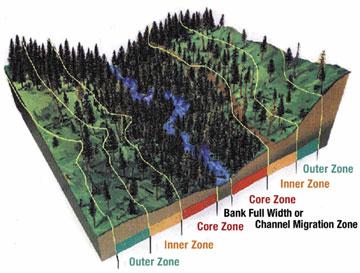
When forest landowners negotiated Forests & Fish, they knew it would mean leaving more trees near the stream to provide protection for fish, water, amphibians, and other wildlife species; and they wanted to provide that protection. Negotiations resulted in larger buffers and emergency rules went into effect in 1999. There are three buffer zones:
Core Zone
The Core Zone is a no-touch buffer that extends outward from the stream for a set distance depending on stream size.
Inner Zone
The Inner Zone (beginning at the edge of the Core Zone) can be managed to allow sufficient growth for healthy riparian areas.
outer Zone
Management activities in the Outer Zone are dependent on many complex factors and are dependent on what management occurred in the inner zone.
The buffers are designed to work together to provide protection for aquatic resources and be as economical as possible for forest landowners. Learn more about riparian buffers on non-fish streams.
Learn More About Managing the Health of a Working Forest